Windows
Mark E. Haskins
October 26, 2026
My eyes are failing. Perhaps yours are, too. Reading now requires glasses. Night driving is a challenge. Product instructions seem printed in 2-point font. There is no doubt the eyes in my head are not what they were. Thankfully though, the “eyes of [my] heart” (Ephesians 1:18) are getting better. The proof of that for all of us is if we see ourselves and others the way our Triune God sees us, knowing that He loves us and we are His joy (John 3: 16 and Hebrews 12: 2).
Several years ago, a work colleague introduced me to the Johari (Yo-har-ee) window as a simple and useful means for categorizing what is seen about us.1 Via a 2-by-2 matrix, intended to look like a four-pane window, we are confronted with two inescapable questions: What do others see in us that we don’t see (our blind spots) and what do we see in ourselves that others don’t (what we keep private)? The basic, original Johari window is:
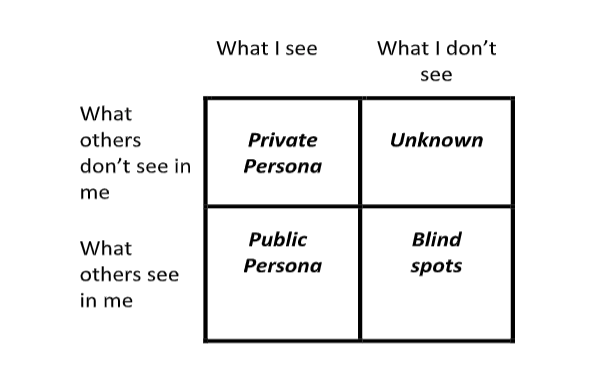
With this simple window in mind and in a secular context, let’s acknowledge that we probably have spent years striving to keep private what we didn’t want others to see while polishing our public persona to try to appear in a certain, preferred way. In either case, it does not matter whether it’s called “posing” or wearing “social camouflage,”2 it’s not being the real us and it is exhausting.3 All true?
Eventually, with the accumulation of a few wrong turns in life, some work-related dead ends and personal derailments, we realize there are things about ourselves we did not see—our blind spots. As a result, hopefully we will get a little bolder. We begin to seek and embrace what others, particularly a spouse, sees in us that we might want to change or nurture. Also, and in a scary sort of way, we begin to let a few close friends shine some light on our blind spots. For me, that was not a comfortable process. It’s now humorous to think of a balding, less-than-chiseled, older guy (me) thinking he was hot stuff on many of his self-designated dimensions. In the end, we all come to realize that we truly do “see in a mirror, darkly” (1 Corinthians 13:12 ASV). Right?
Over time, we also begin to realize that we knew only a bit of the story, a portion of the possibilities, and a tad of the truth about ourselves, others, and even our Heavenly Father. As we mature in following Jesus, we progress in knowing Him and ourselves more fully just as He has always fully known us (I Corinthians 13:12). And what does He see in us? He sees His “workmanship” (Ephesians 2:10 ASV). He sees “…the glory which we will see in the future. For the strong desire of every living thing is waiting for the revelation of the sons of God” (Romans 8:18-19 BBE).
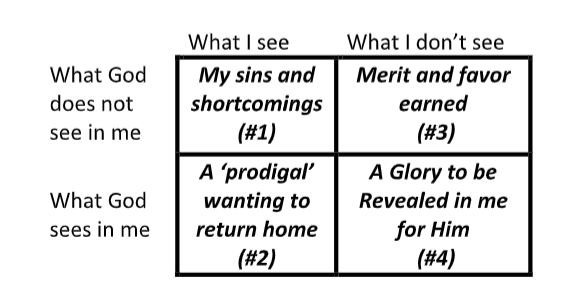
With a bit of literary license, we can convert the original Johari window to a Godly Kingdom four-pane reference window. Perhaps it becomes something like that presented above—a useful reminder and underscoring of who we are in Him. I encourage you to take an extra moment to consider the Kingdom message now posed (and described below) in this new four-pane window.
Our relationship with God begins in windowpane #1. While we were yet estranged from Him, He loved us and reconciled us to Himself (I John 4: 10 and Romans 5: 8-10). What we see there about ourselves ultimately drives us to that very realization which takes us to a windowpane #2 view. Unfortunately, too much man-made religion generally wants to exploit our windowpane #2 convicted heart to remind us we are really windowpane #1 people who must pursue and accomplish windowpane #3 stuff before our Heavenly Father fully accepts the prodigal home. Windowpane #3 has some innate, human appeal because our rational mind and much of contemporary culture tells us that good news has to be earned, that “…everything-has-to-be-hard-and-painful-to-be-good variety…”4 But that is not God’s way! It is not! He says something akin to, “Move away from that view. You have been freely forgiven, no works required and I, your Heavenly Father, don’t even remember your shortcomings let alone hold them against you” (Isaiah 53: 5, Hebrews 10: 17, and Colossians 2: 13-14). Hand in hand, He wants us to know that we are the “fragrance of Christ” and He wants us to see what He sees in windowpane #4 about us “because by one offering He has made complete forever those who are made holy” (II Corinthians 2: 15 TCNT and Hebrews 10:14 BBE).
I believe He goes on to say to us, “I want you to discover more of me and my purposes through a windowpane #4 perspective.” Oh, thank you Lord. We want to humbly learn more about the true, God-given, kingdom-benefiting version of ourselves that He sees. We desire that not for our glory, but for His. There is a reason, purpose, and calling for which He made each of us. Let’s ask Him for “eyes [that are] focused and clear so that [we] can see exactly what it is He is calling [us] to do, grasp the immensity of this glorious way of life He has for his followers, oh, the utter extravagance of His work in us who trust Him…” (Ephesians 1:18-19 MSG). May I offer some holy To-Do’s? Let’s ask Him for the “radical acceptance”5 we need to live in the reality of windowpane #4, in the identity we have in and from Him. Let’s ask Him to enlarge our windowpane #4 perspective and its resultant purposes. Glorious life! Glory in me and in you revealed by, and for Him and this world! Can we embrace a total acceptance of what He reveals and purposes for us?
Let’s also acknowledge that we see and think of ourselves in the context of every age we have ever been.7 That is what makes our stories so unique and rich. As a result, each of us can use today the unique curiosity and energy of our youth. We can use today the unique interest in exploration and learning of our teenage years. We can use today the unique strength and determination of our early adulthood. And we can use today the unique wisdom and focus on Jesus that has come with our gray hair. Buckle up! Thankfully, we can experience windowpane #4 living with Him as catalyst, guide, and faithful indwelling Holy Spirit. Dear Lord, help us to see You more clearly in our daily lives. Help us to see ourselves and others the way You do—as Your workmanship, the recipient of Your deep affection, and as ones who can be Your ministers right where we are. Your purposes and passion are amazing. May we have eyes wide open to see Your purposes and participate in them. Amen.
1 For an overview, see K. Gardiner (August 8, 2023), “How to use the Johari window to improve leadership”, available at https://positivepsychology.com/johari-window/ (accessed 6-16-24).
2 Ash Jurberg (May 5, 2026), “Older Men Reveal the Things They’ve Completely Stopped Caring About—And They Have Zero Regrets,” available at https://www.aol.com/news/older-men-reveal-things-theyve-110019244.html (accessed 5-10-26).
3 Readers are referred to Scott D. Jennings (2026), The Life You Built: Loosening the Grip of What’s False, Embracing What’s True (Independently published) for more discussion of the “false self”.
4 Pam Houston (1992), Cowboys Are My Weakness, (W.W. Norton & Co., NY, NY), p. 75.
5 Jurberg, ibid.
6 For more on our identity in God, see the May 2025 posting at https://thoughtsforachristianheart.com/ titled, “Identity.”
7 An insightful observation by Mitch Albom (2022), Tuesdays with Morrie (Crown Publishing, NY, NY), pp. 120-121.
Notes: ASV (American Standard Version), Published in 1901, in the public domain. MSG (The Message) Scripture taken from THE MESSAGE, Copyright © 1993, 1994, 1995, 1996, 2000, 2001, 2002. Used by permission of NavPress Publishing Group. BBE (Bible in Basic English), Published 1949/1964, in the public domain. TCNT (Twentieth Century New Testament), Revised Edition, Published in 1900-1904 by Fleming H. Revell Company, in the public domain.
Please share this post, and the others preceding it, with friends but only by forwarding its web site link…thank you.
